Compare public ferries and guided boat tours on the Amalfi Coast. See cost, comfort, flexibility, and crowds to pick the right option for your trip.
Options at a Glance
The Amalfi Coast ferry vs boat tour decision comes down to a simple trade: control versus convenience. Public ferries, mostly run by companies under the Campania regional transport umbrella and coordinated with services like SITA Sud buses, link Salerno, Amalfi, Positano, Capri, and sometimes Ravello's port on fixed timetables. Guided boat tours, by contrast, are chartered or small-group trips that follow a route built for sightseeing and swimming rather than getting commuters from A to B.
Neither option is objectively "better" — they solve different problems. If you're staying in Positano and want to see Amalfi for lunch, the ferry is faster and cheaper than driving the SS163 coastal road, which backs up badly in July and August. If you want to swim inside the Emerald Grotto near Conca dei Marini or stop at a cove with no road access, you need a boat tour, because public ferries don't pause for sightseeing.
I'd avoid assuming one option replaces the other entirely. Most travelers spending four or more days on the coast end up using both: ferries for practical transfers between Amalfi, Positano, and Salerno, and one dedicated boat tour for the scenic stretch toward Capri or the grottoes. Treating it as an either/or question usually means either overpaying for transport you didn't need to charter, or missing sights the ferry simply doesn't serve.
Ferries cost less and run on fixed schedules, while boat tours cost more but reach coves and grottoes ferries can't.
Amalfi Coast ferry vs boat tour: cost, flexibility, and access compared
| Option | Typical Cost | Schedule Flexibility | Grotto/Cove Access | Best For |
|---|---|---|---|---|
| Public ferry (Amalfi-Positano) | €8-15 one way | Fixed timetable | No | Quick town-to-town transfers |
| Public ferry (Salerno-Capri) | €15-25 one way | Fixed timetable | No | Longer connections, day trips |
| Shared group boat tour | €60-100 per person | Pre-booked slot, some stop flexibility | Often, as optional add-on | Couples, solo travelers wanting guided sightseeing |
| Private boat charter (small group) | €300-600+ per boat | High, route adjustable | Yes, by request | Families, small groups, senior travelers |
| SITA Sud coastal bus | €2-5 one way | Fixed timetable, frequent delays | No | Backup when ferries are suspended |
Typical figures; fares and schedules vary by season and operator, so check current prices before you travel.
What public ferries offer
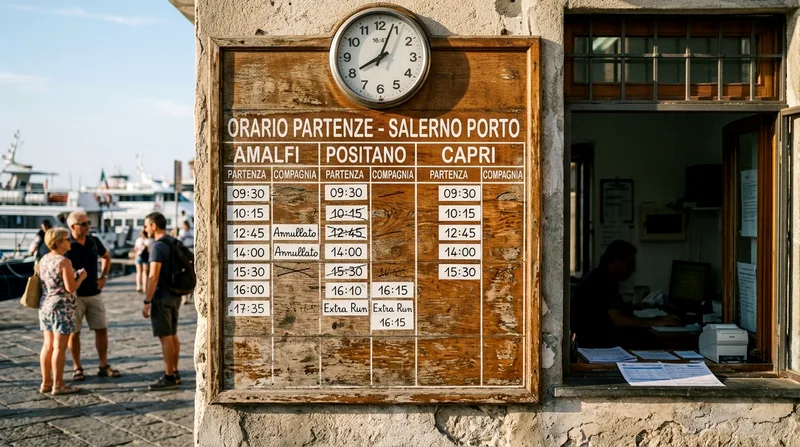
Public ferries run scheduled routes between Salerno, Amalfi, Positano, Minori, and Capri, typically from late March or April through October, with services cut back sharply or suspended in winter. Boats depart roughly every 60 to 90 minutes during peak season on the main routes, less frequently on connections to smaller towns like Cetara or Maiori. You buy tickets at the dock kiosk or sometimes online, walk on, and sit wherever there's space — no guide, no narration, no stops beyond the scheduled piers. It's public transport on water, and it works the same way: cheap, functional, occasionally crowded standing-room-only in August.
What guided boat tours offer
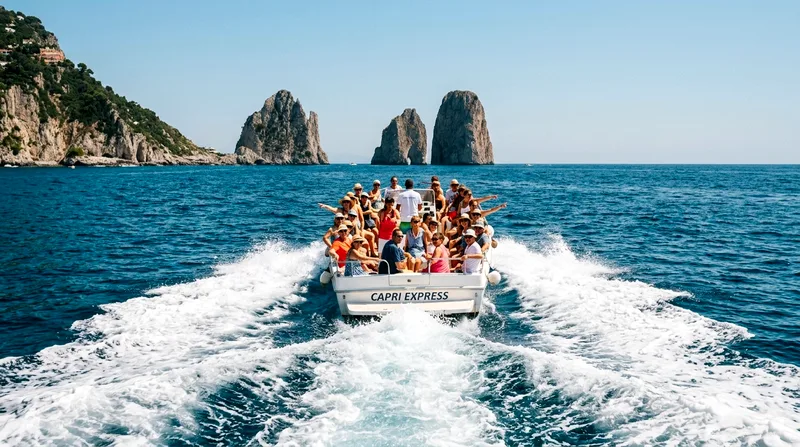
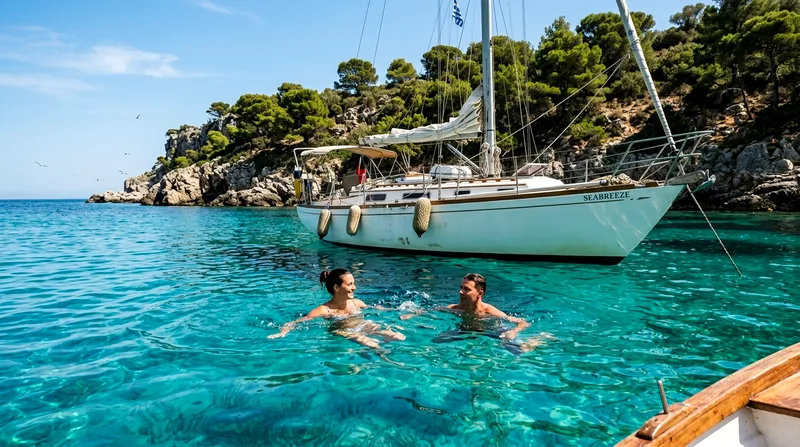
Guided boat tours are built around the coastline itself rather than getting you to a specific town. A typical half-day trip departs from Amalfi, Positano, or Sorrento, cruises close to the cliffs past Praiano and Furore's fjord, stops for 30-45 minutes of swimming in a quiet cove, and often adds the Emerald Grotto as a paid add-on stop. Full-day versions push toward Capri, sometimes circling the island before returning. Group sizes vary widely, from 10-12 people on a shared RIB boat to private charters for two to six. You're paying for the itinerary design and the skipper's local knowledge of where the water's calm enough to swim that day.
Cost: Ferry vs Boat Tour
This is where the amalfi coast ferry vs boat tour decision usually gets settled for budget-conscious travelers. A one-way ferry ticket between Amalfi and Positano typically runs in the €8-15 range; Salerno to Amalfi or Capri connections cost somewhat more, generally €10-20 one way, depending on the route and operator. A day of hopping between three towns by ferry might cost a solo traveler €30-50 total — expensive compared to a bus, cheap compared to almost anything chartered.
Boat tours operate on a completely different cost logic. A shared half-day group tour from Amalfi or Positano commonly falls in the €60-100 per person range; full-day Capri tours or private charters push well past that, often €300-600+ for a private boat for up to six or eight people for several hours. The per-person cost on a private charter actually gets reasonable if you're a group of six splitting it — sometimes cheaper per head than six individual boat tour seats.
My honest take: paying boat tour prices just to get from Positano to Amalfi is a waste of money when the ferry does that specific job for a fraction of the cost. The tour's value is in the stops, the swimming, and the grotto access — not the transport itself. Always compare current prices before you book, since both ferry fares and tour rates shift seasonally and operator to operator.
Ferry pricing structure
Ferry pricing is distance-based and fixed, similar to a bus fare. Short hops like Positano to Amalfi sit at the low end; longer routes to Salerno or across to Capri cost more. There's no dynamic pricing or seasonal surge the way tours sometimes have — the main variable is which operator runs the route, since a few companies compete on busier lines like Amalfi-Capri. Round-trip tickets sometimes offer a modest saving over two one-ways, and some operators sell multi-stop day passes covering several coastal towns, worth checking if you're planning to hop three or more times in one day.
Boat tour pricing structure
Boat tour cost depends on three things: group size, boat type, and duration. Shared tours on a 10-12 person boat are the cheapest per person; private charters cost more in total but give you the full boat and a flexible route. Half-day tours cost less than full-day Capri circuits. Extras like Emerald Grotto entry, lunch stops, or snorkeling gear sometimes cost more on top of the base price, so read what's actually included before comparing two operators' listings — a "€70" tour with grotto entry included may beat a "€60" one that charges extra at the dock.
Comfort and Flexibility Compared
Ferries are rigid. You work around their timetable, which means checking the schedule the night before and building your day around departure times rather than the other way round. Miss the last ferry back from Positano to Amalfi in shoulder season, when frequency drops to every two hours or less, and you're stuck taking the SITA Sud bus along a cliff road that can take twice as long in traffic.
Boat tours flip that — the schedule bends around you, at least within the tour's window. A private charter can wait an extra 20 minutes if you want one more swim, or skip a planned stop if the water's too choppy near Furore. Shared group tours have slightly less flexibility since the skipper is managing everyone's expectations, but there's still far more give than a ferry timetable.
Where ferries win is simplicity and total freedom of timing across a multi-day stay: you decide each morning whether to go to Amalfi or stay in Positano, without having pre-booked anything. Where tours win is onboard comfort for a focused few hours — you're not standing in a packed aisle, and most tour boats have shade, music, and sometimes a drink included.
Schedule and route control
If you want to decide at breakfast whether you're doing Amalfi, Ravello, or Positano that day, ferries support that kind of last-minute flexibility better than any tour booking does, since you're not locked into a pre-paid slot. Tours require booking ahead — often a day or more in peak season — and once booked, you're committed to that date and departure time regardless of weather, which sometimes means a choppier, less scenic ride than you'd hoped for.
Onboard amenities and space
Public ferries have basic seating, an open deck, and minimal shade — fine for a 20-40 minute hop, less fine on a hot August afternoon if the boat's packed shoulder to shoulder. Boat tours, especially private charters, typically offer sun loungers, shade canopies, and enough deck space to actually move around, plus a skipper who'll point out things like the Li Galli islets or a particular villa on the Ravello cliffs that you'd miss entirely on a ferry.
Crowds, Views, and Experience
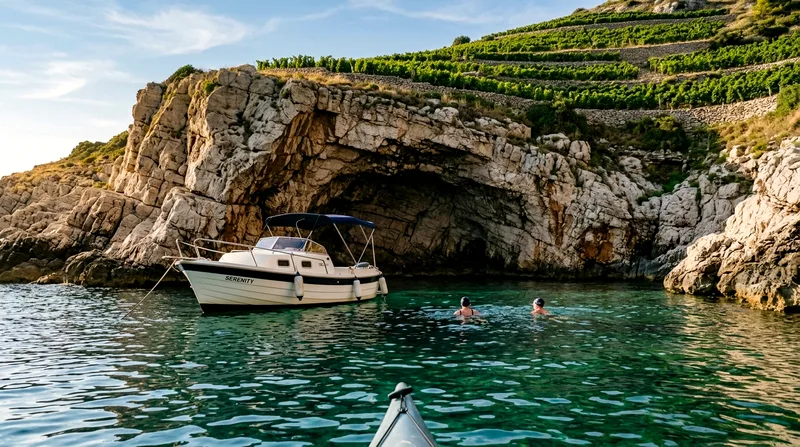
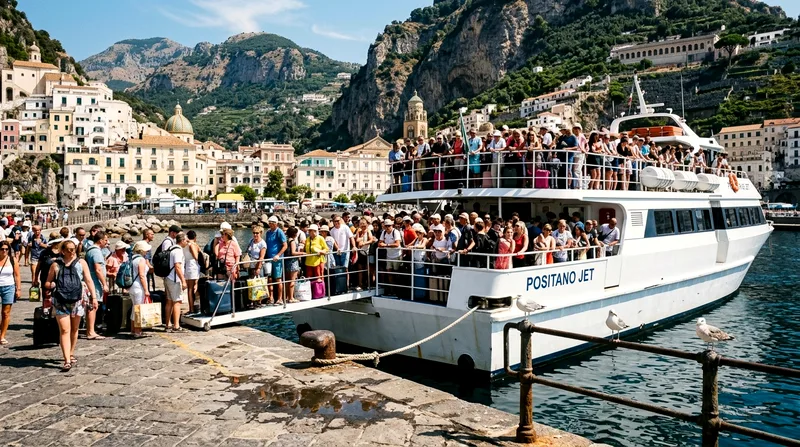
Ferries in peak season — late June through early September — get crowded, particularly the Amalfi-Positano-Capri route around midday when day-trippers from Naples and Sorrento pile on. Expect to stand for part of the trip if you board at a mid-route stop rather than the origin port. The view is still good from the open deck, but you're seeing it alongside 150 other people, some of whom boarded with suitcases heading to the next town.
Boat tours manage crowd density better simply because group sizes are capped and routes avoid the busiest ferry lanes close to port. You'll pass the same cliffs and the same stretch of Tyrrhenian Sea, but from a boat that stops specifically for photos or swimming rather than ferry traffic management.
Tourist density and atmosphere
Ferries feel like transit — functional, sometimes a bit chaotic at the gangway, with queues forming 15-20 minutes before departure at popular stops like Positano's Spiaggia Grande dock. Boat tours feel like an outing: smaller groups, a skipper who usually speaks to passengers directly, and a slower pace built around looking at things rather than reaching them.
Access to hidden coves and stops
This is the clearest functional gap. Ferries stop only at designated piers in towns — Amalfi, Positano, Salerno, Capri, occasionally Cetara or Maiori. They do not stop at the Emerald Grotto, nor at the small coves along the Conca dei Marini and Furore coastline that have no dock. Boat tours exist specifically to reach those spots, which is the strongest argument for booking one if swimming in a quiet inlet matters more to you than saving €40.
Who Should Choose Which
Solo travelers and couples on a tighter budget should default to ferries for getting between towns, saving the splurge for one guided tour focused on the grottoes or Capri. Families with young children often do better on a private boat charter rather than a shared tour or crowded ferry — you control timing around naps and meals, and a charter operator can usually accommodate a shorter, calmer route. Senior travelers who find scrambling on and off a crowded ferry at a floating pontoon dock physically awkward may prefer the more controlled boarding process of a private tour, even at a higher price.
Groups of four to eight get the best value from a private charter split between everyone, since the per-person cost can come close to a shared group tour while getting the whole boat. If your main goal is simply reaching Ravello's port, Salerno, or Capri from your base, skip the tour and take the ferry — it's the same water, a fraction of the price, and you won't sit through anyone else's itinerary.
Compare current ferry schedules and boat tour prices before you book, since both shift by season and neither is worth overpaying for once you know which one actually matches what you want from the day.
Frequently asked questions
Are public ferries cheaper than boat tours on the Amalfi Coast?
Yes, by a wide margin for point-to-point travel. A ferry between Amalfi and Positano typically costs €8-15 one way, while even a shared boat tour starts around €60-100 per person. Ferries are built for transport; tours are built for sightseeing, and the price reflects that extra experience, not just the ride.
Can you book a ferry and boat tour on the same day?
Generally not practically. A boat tour usually occupies a half-day or full-day slot, leaving little time to also catch scheduled ferries unless your tour starts very early or ends by mid-afternoon. Most travelers use ferries on separate days from a booked tour rather than trying to combine both in one outing.
Which option is better for avoiding crowds?
Boat tours, especially private charters, since group sizes are capped and routes deliberately avoid the busiest ferry lanes. Public ferries get genuinely crowded on the Amalfi-Positano-Capri route between June and September, particularly around midday departures.
Do ferries run year-round on the Amalfi Coast?
No. Most routes operate from roughly April through October, with frequency dropping sharply in shoulder months and many services suspended entirely in winter. If you're visiting November through March, plan on the SITA Sud bus or a car instead, and don't assume the ferry will be running.
What's included in a typical guided boat tour?
A standard half-day tour usually includes the skipper, fuel, and a swimming stop in a cove along the coast toward Praiano or Furore. Extras like Emerald Grotto entry, snorkeling gear, or lunch are often optional add-ons rather than automatically included, so check the listing details before comparing prices across operators.