Compare Villa Rufolo and Villa Cimbrone tickets on the Amalfi Coast. Learn what's included, pricing options, and whether guided tours are worth it.
What Are Villa Rufolo and Villa Cimbrone?
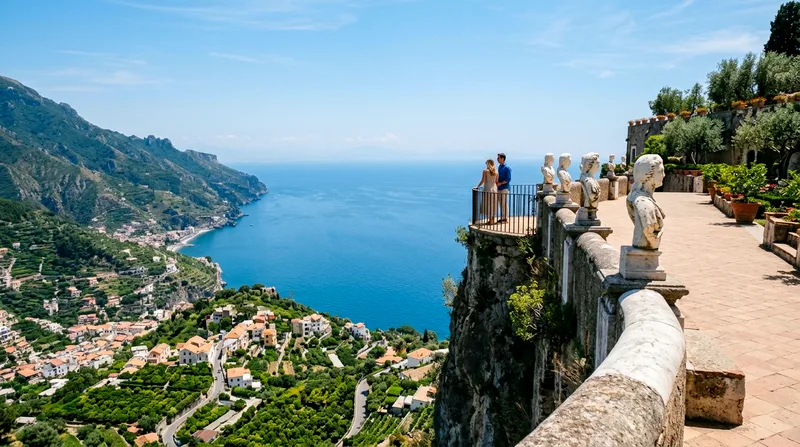
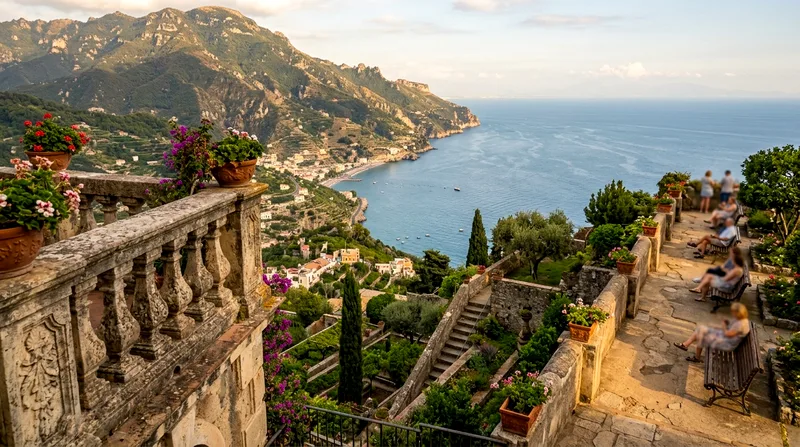
Ravello sits about 365 meters above the coast, reached by a winding 20-minute drive or bus ride up from Amalfi, and its two signature attractions are garden estates rather than museums. Villa Rufolo tickets get you into a 13th-century complex with Moorish-influenced towers and a terrace that looks straight down the coastline toward Amalfi and Minori. Villa Cimbrone tickets cover a later, more romantic 19th-century creation — an English aristocrat's reconstruction of a medieval villa, built around a cliffside garden that ends at the Terrace of Infinity.
Both sit within a 10-minute walk of Ravello's main square, Piazza Duomo, which makes pairing them in one visit straightforward. Neither is large — you can walk the full grounds of either in 30 to 45 minutes — but they reward slow movement more than a checklist pace. If you're the type who speed-walks through gardens to get to the "main view," you'll get less out of either ticket than someone willing to sit on a bench for ten minutes.
Villa Rufolo: history and highlights
Villa Rufolo dates to the 13th century, built by the Rufolo family, Ravello merchants wealthy enough that Boccaccio referenced them in the Decameron. Richard Wagner visited in 1880 and reportedly found inspiration for Act II of Parsifal in the gardens — which is why the villa now hosts the Ravello Festival, an outdoor concert series held on the terrace in the warmer months. The grounds mix Arab-Sicilian towers, a cloister, and tiered gardens planted with palms, roses, and bougainvillea, stepping down toward the famous terrace overlook. That terrace — with its lawn, umbrella pines, and sea backdrop — is the single most photographed spot in Ravello, and it's the image used on most regional tourism material.
Villa Cimbrone: history and highlights
Villa Cimbrone's current form dates to the early 1900s, when English Lord Grimthorpe (Ernest William Beckett) bought a ruined medieval property and rebuilt it as a personal retreat, working with local craftsman Nicola Mansi. The result reads as deliberately atmospheric rather than historically pure — cloisters, a crypt, a "Temple of Bacchus," and statuary scattered through wisteria-covered walkways. The grounds end at the Terrace of Infinity, a stone balustrade lined with marble busts that frames an open sea view with no buildings in sight. Garbo and Virginia Woolf both reportedly stayed here, which the villa's marketing leans on heavily. The walk from the entrance to the terrace takes about 10-15 minutes through several distinct garden rooms, which is longer and arguably more varied than Rufolo's more compact layout.
What's Included in Each Ticket
A standard Villa Rufolo ticket covers the gardens, the towers' exteriors, the cloister, and access to a small on-site museum space with archaeological finds. A standard Villa Cimbrone ticket covers the full garden circuit, the cloister, the crypt, and the Terrace of Infinity. Neither ticket is a guided tour by default — you're buying entry and walking the grounds at your own pace with posted information panels along the paths.
Garden access and what you'll see
At Villa Rufolo, expect stepped garden terraces, a central lawn framed by two towers, and sweeping views toward the Bay of Salerno — this is the spot where you'll see the most other tourists, since it's also a wedding and event venue. At Villa Cimbrone, the ticket takes you through rose gardens, a wisteria pergola (best in late April to May), and a woodland stretch before opening onto the Terrace of Infinity. If you only have time for one coastal view in Ravello, Cimbrone's terrace is less crowded earlier in the morning, since most day-trippers hit Rufolo first because it's closer to the bus stop and piazza.
What's not included (tours, meals, events)
Standard tickets don't include a guide — if you want commentary, you'll need to book a separate guided walking tour of Ravello that typically stops at both villas, or hire a licensed local guide independently. Neither ticket includes food; Villa Cimbrone has a terrace bar/restaurant area near the grounds, but it's a separate charge and not part of garden admission. Ravello Festival concert tickets at Villa Rufolo are sold separately from day entry and only run during the festival season (roughly June through September, though exact dates vary and should be confirmed on the festival's own site). Don't assume a Rufolo ticket gets you into a concert — it doesn't.
Ticket Options and Pricing Comparison
Pricing at both villas is modest by European garden-attraction standards — think somewhere in the €7 to €10 range for standard adult entry at each, with reduced rates for students, seniors, and children, though you should always confirm the current figure on the official site or at the ticket window before you go, since these do get revised. There is no consistently available official joint ticket covering both villas; despite what some resale sites imply, Rufolo and Cimbrone are independently managed, so you buy entry to each separately.
Villa Rufolo suits a quick coastal-view stop near the piazza, while Villa Cimbrone rewards a longer, quieter walk to its clifftop terrace.
Villa Rufolo tickets vs Villa Cimbrone tickets: what to expect
| Villa | Typical visit time (min) | Walking difficulty | Best feature | Crowd level |
|---|---|---|---|---|
| Villa Rufolo | 30-45 | Easy, mostly flat | Terrace view of the coast and towers | High, especially midday |
| Villa Cimbrone | 45-60 | Moderate, some uneven paths | Terrace of Infinity | Lower, especially early morning |
Approximate figures based on typical garden layouts and visitor patterns; always confirm current opening hours and admission on each villa's official site before visiting.
Standard garden entry vs. guided tour options
Standard entry is self-guided and, frankly, sufficient for most visitors — the gardens are compact enough that getting lost or missing the highlights isn't really possible. Guided tour options exist mainly as part of broader Ravello or Amalfi Coast day-tour packages booked through tour operators, often combining a villa visit with a walk through the historic center or a stop in Amalfi town. These add real value if you want historical context on the Rufolo family or Lord Grimthorpe, or if you're traveling with teenagers who tune out at plain gardens but perk up for stories about Wagner or Greta Garbo. If you're a solo traveler or a couple comfortable reading a panel and moving on, skip the guide and put that money toward lunch on Ravello's panoramic terrace restaurants instead.
Combination tickets and seasonal variations
Watch out for third-party booking platforms advertising "Ravello combo tickets" — some bundle villa entry with a coach transfer from Sorrento or Positano rather than an actual discounted joint admission, and the markup over buying direct can be significant. Seasonal variation matters more for comfort than access: both villas stay open through winter with shorter effective daylight for photography, while summer brings heat that makes the shaded Cimbrone woodland paths more pleasant than Rufolo's more open, sun-exposed terraces. Spring (April-May) is genuinely the best stretch for garden condition, with wisteria and roses in bloom at Cimbrone and greener lawns at Rufolo.
Where and How to Buy Tickets
For most visitors, buying tickets on-site at each villa's ticket window is the simplest approach — queues are rarely long outside of peak midday hours in July and August, and there's no advantage to pre-booking through a third party for standard entry. Villa Rufolo's ticket office sits just off Piazza Duomo, so it's the first thing you'll encounter walking into Ravello's center. Villa Cimbrone's entrance is a short walk further along Via Santa Chiara, past small shops and a few viewpoints worth a photo stop anyway.
Official channels and booking platforms
Each villa maintains its own official website where you can check current admission prices, hours, and any festival-related closures — this is the only source you should trust for live information, since aggregator travel sites often carry outdated hours or inflated prices. If you want to book online in advance, do it through the villa's own site rather than a general ticket marketplace; the latter often just resells standard entry at a markup with no added benefit. Avoid any site promising "skip the line" access for these two villas specifically — lines are rarely the bottleneck here, unlike at Pompeii or the Vatican, so you're paying extra for a problem you likely won't have.
Best time to book and advance purchase tips
You generally don't need to book Villa Rufolo or Villa Cimbrone tickets days in advance — same-day purchase at the gate works fine outside of major holidays and the peak of the Ravello Festival, when Rufolo's grounds may have restricted access for stage setup. If you're visiting between late June and September, arrive before 10:30am or after 4pm to avoid both the heat and the cruise-excursion crowds arriving via bus from Amalfi and Sorrento. Combine your visit with the SITA bus schedule from Amalfi — buses run roughly every 30-60 minutes depending on season, so check current timetables rather than assuming frequency, since missing one can mean a long wait in a small piazza with limited shade.
Is It Worth Visiting? By Traveller Type
Families with young children may find both villas a bit sedate — there's no playground energy here, and the appeal is entirely in the views and atmosphere. Older kids and teenagers tend to do better at Cimbrone, where the longer path and crypt/temple features give them something to explore rather than just admire. Senior travelers should note Rufolo's flatter layout is the easier of the two; Cimbrone has some uneven stone paths and a longer walk, though nothing as punishing as the Path of the Gods hike between Agerola and Positano.

For history buffs and cultural tourists
History buffs get more from Rufolo — the 13th-century Arab-Sicilian architecture and direct connection to Wagner and the Decameron-era merchant families give it real documented depth. Cimbrone's story is compelling but more recent and more theatrical: an early-1900s British reconstruction designed to look older than it is, built for aesthetic effect rather than authentic medieval use. If you've just come from Pompeii or Naples' Archaeological Museum and want genuine antiquity, Rufolo edges it; if you want atmosphere and a good story about Bloomsbury-set visitors, Cimbrone delivers.
Frequently asked questions
Can you visit both villas in one day?
Yes, easily. They're roughly a 10-minute walk apart in central Ravello, and each visit takes 30-60 minutes. Budget half a day including the walk between them, lunch, and time in Piazza Duomo, especially if you're also commuting up from Amalfi or Positano by bus.
Do Villa Rufolo and Villa Cimbrone tickets include guided tours?
No. Standard tickets for both are self-guided entry with on-site information panels. Guided tours are sold separately, usually as part of broader Ravello or Amalfi Coast day-tour packages rather than villa-specific add-ons.
What's the best time to visit these villas?
Late April through May for garden bloom, particularly Cimbrone's wisteria. For crowds and light, arrive before 10:30am or after 4pm in summer. Avoid visiting Villa Rufolo during the Ravello Festival (roughly June-September) without checking for stage-related access restrictions first.
Are there discounts for families or groups?
Both villas typically offer reduced admission for children, students, and seniors, and children under a certain age (commonly around 6-10) often enter free — exact thresholds and current prices should be confirmed on each villa's official site, since they do change.
Can you book tickets online in advance?
Yes, through each villa's official website. Advance booking isn't essential outside major holidays or festival dates, since on-site queues are rarely long, but booking online does let you confirm hours and avoid arriving on an unexpected closure day.