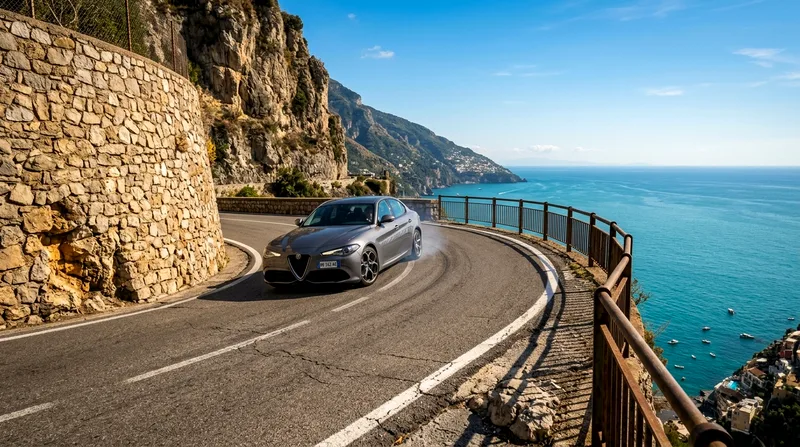
Compare private car, minivan & luxury transfers to Amalfi Coast from Naples airport, train stations & Rome. What to book, when, and what to avoid.
Who private transfers suit best
Private transfers solve a specific problem: the Amalfi Coast's one main road — the SS163 — is narrow, cliffside, and prone to summer traffic jams that can turn a 40-minute drive into two hours. Public buses (SITA) are cheap, around €2-5 a ticket, but they're standing-room-only in July and August, and they won't take you door-to-door with four suitcases. A private transfer removes that variable. You get picked up where you land, dropped where you sleep, no transfers, no timetables.
That reliability has a cost. Expect to pay several times what a bus or shared shuttle would charge, and the saving in time and hassle is really what you're buying, not luxury for its own sake. If you're relaxed about schedules and traveling light, the bus from Sorrento to Positano or Amalfi town is a perfectly reasonable alternative, and plenty of backpackers and younger couples use it without regret.
Where private transfer earns its price is specifically on the arrival and departure legs — Naples Airport to your hotel, or Salerno train station to Ravello — when you're jet-lagged, carrying bags, and don't want to figure out a bus connection in a language you don't speak. It's less essential for getting between coastal towns once you're settled, where ferries between Positano, Amalfi, and Capri are often faster and more scenic than any road transfer could be.
Groups and families
For three or more people, a private transfer usually costs about the same per person as public transport once you add up individual bus or taxi fares — sometimes less. Families traveling with car seats, strollers, or more than one large suitcase per person benefit most, since minivans handle luggage that would overwhelm a standard sedan. Confirm car seat availability when booking; not every operator stocks them, and Italian law requires age-appropriate restraints for children under 150cm. If you're a family of five or more, check vehicle capacity carefully — many "8-seater" minivans fit 6 adults comfortably once luggage is loaded.
Solo travelers and couples
A solo traveler paying for a private car alone is paying the full vehicle rate, which is the weakest value case for this type of booking — a seat on a shared shuttle or the Curreri bus from Naples Airport to Sorrento (around €10-15) will do the job for far less. Couples sit in a better spot: splitting the fare in half often lands close to what two shared-shuttle tickets would cost, with the advantage of a direct route and no extra stops. If you're a couple arriving late at night or flying into Naples with an early onward connection, the private option's fixed schedule is worth the premium.
Transfer types compared
"Private transfer" covers a range of vehicles, and the category you pick should be driven by group size, luggage volume, and how much you care about arriving in a nice car versus arriving on time in any car. Broadly, you're choosing between a standard sedan, a minivan, and a luxury sedan or SUV tier — each with different capacity, comfort, and price positioning.
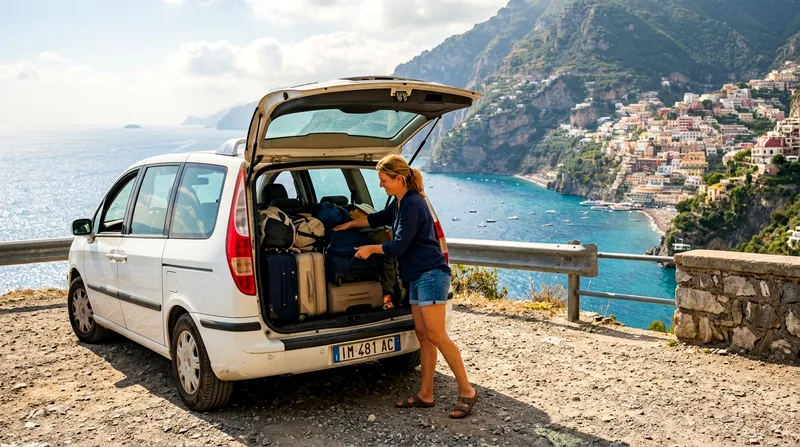
The biggest mistake I see booked is mismatching vehicle size to road reality. A full-size minivan is excellent for a family of six with bags, but it's a clumsy, slow choice for the tightest switchbacks into Positano or Praiano, where a smaller sedan or an experienced local driver in a compact car will actually move faster. If your hotel is up a narrow lane — common in Positano and Ravello — ask whether the vehicle can reach the door or whether you'll need a short walk or a porter.
A standard sedan suits couples and solo travelers, while minivans and luxury sedans serve larger groups or those prioritizing comfort over cost.
Amalfi Coast private transfer vehicle types compared
| Vehicle type | Typical capacity | Luggage fit | Best for | Relative cost |
|---|---|---|---|---|
| Standard sedan | 3 passengers | 2-3 suitcases | Couples, solo travelers | Lowest |
| Minivan | 6-8 passengers | 5-8 suitcases | Families, groups | Moderate |
| Luxury sedan | 3 passengers | 2-3 suitcases | Couples wanting comfort | High |
| Luxury SUV/van | 5-7 passengers | 4-6 suitcases | Small groups wanting comfort | Highest |
Capacity and luggage allowances vary by operator and vehicle model; confirm exact limits when booking.
Standard private car vs minivan
A standard private car (sedan or small SUV) typically seats 3 passengers comfortably with 2-3 standard suitcases, and suits couples, solo travelers, or small families. It's generally the cheapest private option and the most maneuverable on the coastal road, which matters more than people expect — tour buses and minivans frequently have to reverse at blind corners near Amalfi and Positano. A minivan (usually 6-8 seats) suits groups and families with more luggage; expect to pay more than the sedan rate, but less than booking two separate cars. The trade-off is a slower, less agile ride, and some drivers will charge extra for routes involving very narrow village centers.
Luxury sedan options
Luxury transfer Amalfi Coast listings typically mean a Mercedes E-Class or similar, sometimes with a dedicated English-speaking driver, bottled water, and flexible wait times built in. This tier costs noticeably more than a standard car — often 50-100% more — and the actual functional difference (comfort, legroom, driver professionalism) is real but incremental. It makes the most sense for anniversary trips, honeymoons, or senior travelers who want extra assistance with luggage and mobility, less sense if you're simply trying to get from Naples Airport to Sorrento efficiently. Don't assume "luxury" means a bigger vehicle — most luxury sedans still only seat 3 passengers.
Pickup locations and routes
Most private transfers to the Amalfi Coast originate from one of three points: Naples Airport, Naples or Salerno train stations, or Rome. Where you land shapes both journey time and price, and it's worth checking whether a train-plus-short-transfer combination beats a long direct drive.
Naples airport and train station
Naples Airport to Amalfi Coast transfer journeys typically run 70-90 minutes to Sorrento or Positano, and up to two hours to Amalfi or Ravello in heavy traffic, which is common on summer afternoons. This is the single most-booked route for visitors, and for good reason — the alternative is an airport bus to Naples Centrale, a train to Sorrento, then a local bus or taxi, which can easily take three hours with transfers. Salerno train station is the better arrival point if you're headed straight to Amalfi, Ravello, or the coast's eastern half, cutting 20-30 minutes off the drive compared to starting from Naples. If your flight lands late, confirm the driver tracks your flight number — reputable services monitor arrivals and adjust pickup time for delays at no extra charge.
Rome to Amalfi Coast
A private car from Rome to Amalfi Coast covers roughly 250-280 km and takes 3-3.5 hours by highway, depending on your exact destination and traffic around Naples. It's a long transfer and priced accordingly — several times the cost of the Naples Airport route — so compare it honestly against taking a high-speed train from Rome to Naples (about 70 minutes) followed by a shorter private transfer from there. For most travelers the train-plus-transfer combination is both cheaper and faster door-to-door; the direct Rome car makes more sense only if you have heavy luggage, mobility constraints, or want to stop at Pompeii or Naples itself en route.
What to check before booking

Booking a transfer is simple, but the listings vary more than they first appear, and the details that matter are rarely the headline price.
Inclusions and add-ons
Check whether the quoted rate includes tolls, parking at your destination, and waiting time for flight delays — these are sometimes bundled, sometimes billed separately. Confirm the number of suitcases included; many listings cap it at one large bag per passenger, with excess luggage charged extra or simply refused if the car's trunk can't fit it. If you need a car seat, a wheelchair-accessible vehicle, or a stop in Pompeii or Naples en route, ask before booking — these aren't always available on demand, and the driver qualifications (commercial license, English fluency) can also vary, so check reviews mentioning driver communication specifically.
Cancellation and modification policies
Cancellation policies differ sharply between operators — some offer free cancellation up to 24-48 hours before pickup, others lock in payment once booked. Given how often flights shift by a few hours, prioritize listings with free date/time modification rather than focusing purely on price. Read the fine print on no-show policies too: if your flight is delayed beyond the driver's grace period (often 60-90 minutes for airport pickups) without notice, you may be charged again for a second pickup.
When and how to book
Book an Amalfi Coast private transfer at least 3-5 days ahead in shoulder season, and a full 2-3 weeks ahead for July, August, or any date around Easter, when demand for cars and drivers spikes along with every hotel and restaurant on the coast. Waiting until arrival rarely saves money and often means settling for whatever's left — typically an overpriced taxi queue option at the airport with no price transparency at all.
For first-time visitors juggling Naples Airport logistics, a direct comparison against public transport is useful: the Curreri bus or Alibus to Naples Centrale costs a fraction of a private transfer but adds at least one more connection and 45-60 minutes. If you're staying in Positano or Ravello specifically, factor in that both towns have restricted vehicle access in their historic centers, so even a private driver may drop you at a stand some distance from your hotel door — ask about this when booking, not on arrival.
Compare current prices and reviews before you book, since rates shift with season, fuel costs, and vehicle availability. Pair the transfer booking with your onward plans — a Capri day trip by ferry from Sorrento, or a scenic drive itinerary toward Ravello — so the car arrives exactly when your schedule needs it, not a generic daytime slot.
Frequently asked questions
How much does a private transfer to Amalfi Coast cost?
Pricing depends heavily on distance, vehicle type, and season, so there's no fixed figure — a Naples Airport to Sorrento sedan transfer costs noticeably less than a Rome to Amalfi coast minivan, and summer rates run higher than shoulder season. Rather than anchoring to a number, compare 2-3 current listings for your exact route and date, checking that tolls and luggage are included before you compare totals.
Can I book a private transfer from Rome to Amalfi Coast?
Yes, direct transfers from Rome run about 3-3.5 hours and 250-280 km, but it's worth pricing this against taking a high-speed train to Naples (roughly 70 minutes) followed by a shorter local transfer, which is usually both cheaper and faster unless you have heavy luggage or want a stop in Pompeii en route.
What's included in a private transfer service?
Most include door-to-door pickup, one driver, and a set number of suitcases per passenger, but tolls, waiting time, car seats, and extra stops vary by listing. Always check the inclusions list before booking rather than assuming — a cheaper quote sometimes excludes tolls or caps luggage at one bag per person.
How far in advance should I book a private transfer?
Book 3-5 days ahead in spring or fall, and 2-3 weeks ahead for July, August, or Easter week, when vehicle availability on the coast tightens considerably. Last-minute bookings aren't impossible but usually mean fewer vehicle choices and higher prices.
What's the difference between a private car and minivan transfer?
A standard private car seats about 3 passengers with 2-3 suitcases and handles the coastal road's tight corners more easily, while a minivan seats 6-8 with more luggage room but moves slower on narrow village streets. Choose the car for couples or solo travelers, the minivan for families or groups of four or more.