A slower-paced Amalfi Coast 5 day itinerary for families and seniors, with hidden villages, day trips, boat tours, and built-in downtime.
Who This Itinerary Is For
This Amalfi Coast 5 day itinerary is built for people who want to see the coast properly, not just photograph it from a bus window. It suits families with children who need lunch breaks and shorter walks, senior travelers who want fewer transfers and more sit-down meals, and couples who'd rather linger over a view than check off five towns in one day.
It is not for travelers trying to combine the Amalfi Coast with Rome, Florence, and Venice in one go. That approach leads to two rushed days here, a missed boat, and a lot of standing on the SITA bus. If your trip includes the Amalfi Coast as one stop in a longer Italy tour, consider trimming this plan to three focused days around Amalfi town and Positano, and save Ravello and the Emerald Grotto for a return visit.
The plan below assumes a base (or two) rather than constant movement, uses ferries over buses wherever the sea route exists, and treats one afternoon as genuinely free — no itinerary, no ticking boxes. That's a deliberate choice: the coast's roads are narrow, slow, and often jammed between May and September, and padding every day to the brim is how good trips turn into tiring ones.
Each day of this Amalfi Coast 5 day itinerary suits a different pace, so match the heavier walking days to when your group has the most energy.
Amalfi Coast 5 day itinerary: daily highlights, travel time, and best fit
| Day | Main Stop | Travel Time From Base | Walking Level | Best For |
|---|---|---|---|---|
| Day 1 | Positano | Approx. 75-90 min from Naples | High (steps) | Couples, first views |
| Day 2 | Amalfi & Atrani | 20-25 min ferry from Positano | Low-Moderate | Families, seniors |
| Day 3 | Ravello | Approx. 25 min bus from Amalfi | Low (flat gardens) | Seniors, slow travel |
| Day 4 | Emerald Grotto & Praiano | 15-20 min boat/drive from Amalfi | Low-Moderate | Families, swimmers |
| Day 5 | Leisure day | None (local only) | Minimal | Everyone |
Travel times are typical and vary with season, ferry schedules, and traffic; always check current timetables before you travel.
Day 1: Arrival and Positano
Most visitors arrive via Naples airport or Salerno, then transfer by car, private driver, or a combination of train and ferry. Expect roughly 75-90 minutes from Naples to Positano by road, more in peak traffic.
Morning and afternoon
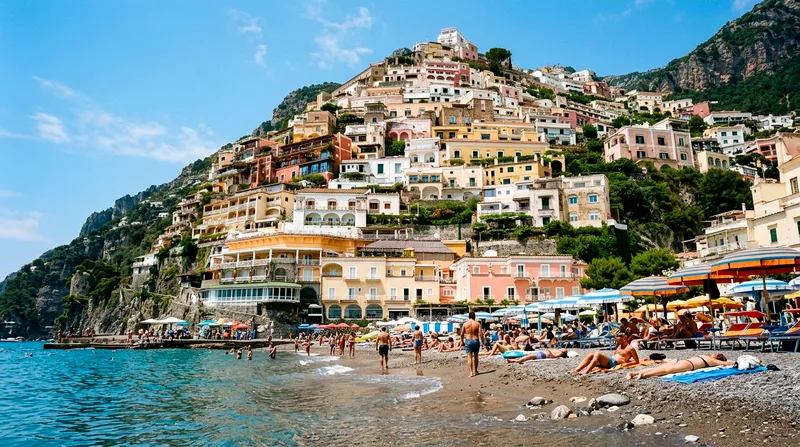
If you're arriving by midday, head straight to Positano and check into your accommodation before doing anything else — hauling luggage down (and later up) Positano's stepped lanes is miserable in the afternoon heat. Spend the rest of the day acclimating: walk down to Spiaggia Grande, the main beach, and settle in for a couple of hours. Families should know the beach is mostly pebble, not sand, so pack water shoes for kids. Senior travelers should budget extra time for the return climb, or take one of the small local shuttle vans that run up to the main road for a few euros.
Evening
Book a sunset boat tour along the Positano coastline for this evening if you're not too jet-lagged — many local operators run short two- to three-hour trips that need reserving a day ahead in high season. It's the easiest way to see the cliffs properly on day one without any walking. If you'd rather stay on land, a simple dinner on a terrace restaurant above the harbor gives nearly the same view without the boat.
Day 2: Amalfi Town and Atrani
Take the ferry from Positano to Amalfi town — about 20-25 minutes, running frequently from spring through autumn, though schedules thin out or stop entirely in winter, when a bus becomes the only option.
Morning and afternoon
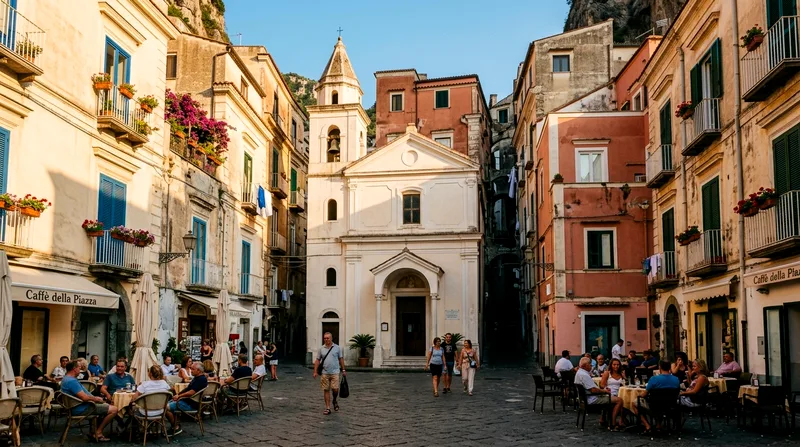
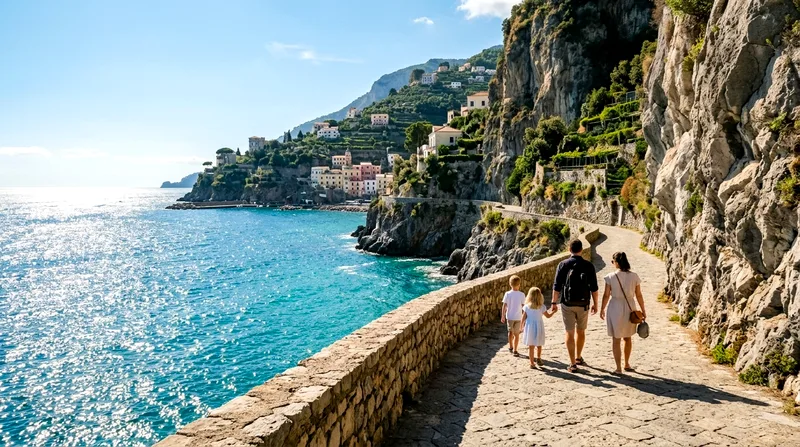
Amalfi town is flatter and easier on the legs than Positano, which makes it a good match for families and seniors alike. Visit the Cathedral of Sant'Andrea and its cloister (entry is a few euros), then wander the small streets behind the main square, away from the cruise-ship crowds that cluster near the harbor midday. For lunch, walk the ten minutes along the coastal path to Atrani — a genuinely quieter village that most day-trippers skip entirely because it's not on the main ferry stop list. Its tiny piazza, lemon trees, and a beach smaller than Positano's make it one of the better "hidden village" stops on this coast.
Evening
Stay for dinner in Atrani rather than heading back to Amalfi — it's noticeably cheaper and less touristy, and the walk back to your ferry or hotel afterward is short and well-lit. If you're based in Amalfi itself, an evening stroll along the harbor after the day-trip crowds clear out is worth the wait.
Day 3: Ravello and Mountain Villages
Ravello sits about 350 meters above the coast, reachable by bus from Amalfi in around 25 minutes, or by taxi in less time but at a higher cost.
Morning and afternoon
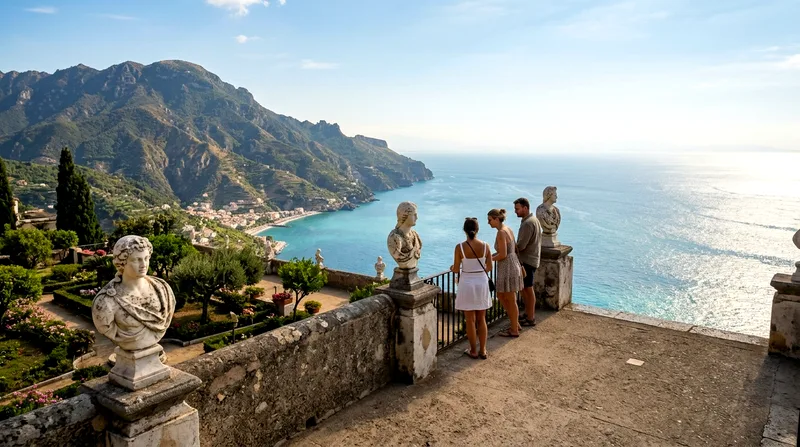
Ravello trades beaches for gardens and views, which makes it the right call on a day when legs are tired from stairs. Villa Rufolo and Villa Cimbrone both have terraced gardens looking straight down over the Tyrrhenian Sea, and both are flat-path, pram- and cane-friendly in a way almost nothing else on this coast is. Entry to each villa runs a modest fee, worth paying for Cimbrone especially — its "Terrace of Infinity" is one of the better non-boat viewpoints on the whole coast, arguably better than anything from Positano's beach level.
Evening
Ravello is cooler than the coast at night, so bring a light layer. Dinner here tends to be quieter and slightly more refined than in Amalfi or Positano, and reservations matter less — a reasonable trade-off for travelers who find the coastal towns too busy by evening. Head back down by bus or taxi; don't attempt the walking paths after dark, since lighting is inconsistent.
Day 4: Emerald Grotto and Praiano
This day leans toward the water. The Emerald Grotto (Grotta dello Smeraldo), between Amalfi and Praiano, is reached by small rowboat from a lower entrance or by road with a short staircase down.
Morning and afternoon
Go early — by midmorning, tour groups arrive and the grotto's narrow dock gets crowded. Entry costs a small fee and includes the short rowboat ride inside, where the green light effect comes from sunlight filtering through an underwater opening. It's a 15-20 minute visit total, not worth building a whole day around on its own, which is why pairing it with Praiano works well. Praiano itself is smaller and far less developed than Positano, with fewer shops and tour groups, and its two small beaches — Marina di Praia and Gavitella — are genuinely good swimming spots with a fraction of Positano's beach-chair prices.
Evening
Praiano has a reputation among locals for some of the best sunset views on the coast, partly because it faces west without Positano's cliffs blocking the horizon. A seafood dinner near Marina di Praia, with the grotto visit behind you, makes for a calm final full day rather than another transfer-heavy one.
Day 5: Leisure Day and Departure
This is the day most five-day itineraries skip, and it's the one I'd argue matters most for families and seniors.
Morning and afternoon
If your flight or train is in the afternoon or evening, resist booking another big excursion. Use the morning for a slow breakfast, a last swim, or a return visit to whichever town you liked best — repeat visits often reveal a better lunch spot or quieter corner than the first pass did. Families with young kids will appreciate having zero schedule pressure on a travel day; seniors will appreciate not climbing one more set of stairs under time pressure.
Evening
Departures typically route through Naples or Salerno. Build in at least 2.5-3 hours for the transfer to Naples airport from Positano or Amalfi, since coastal traffic is unpredictable even outside peak season. If you're catching a train from Salerno instead, that connection is more reliable and roughly 30-40 minutes by car from Amalfi.
Where to Base Yourself
Positano is the obvious choice and the most photographed, but it's also the steepest, the most expensive, and the most crowded in peak summer. If stairs are a concern, it's arguably the worst base on this list despite the views.
Amalfi town is flatter, more central for ferries to Positano, Salerno, and Capri, and generally cheaper for food and lodging. It's my preferred base for families and seniors doing this five-day plan, since it cuts down on daily transfer time to almost everything else here.
Ravello works as a base only for travelers who don't mind commuting down to the water each day — it's quieter and cooler, but you'll spend more time on buses. Sorrento, just outside the Amalfi Coast proper, is another common base: it has easier road and rail access to Naples and Pompeii, and slightly lower prices, but it adds 45-60 minutes of travel time to reach Positano or Amalfi each day, which erodes the "relaxed" part of a relaxed itinerary. Basing in Salerno is cheaper still and has a direct ferry network, but it feels more like a city than a coastal base.
Getting Around the Amalfi Coast
Ferries are the best way to move between coastal towns from spring through early autumn — faster than the bus, often more scenic, and they skip the traffic jams on the Amalfi Coast's single narrow highway entirely. The trade-off is that ferry schedules shrink or stop in winter, when SITA buses become the main option.
Buses are cheap and run frequently, but they're often standing-room only in July and August, and the road's switchbacks are genuinely uncomfortable for anyone prone to motion sickness. Renting a car is possible but not something I'd recommend for most visitors — parking is scarce and expensive, the road is one lane each direction with blind curves, and a private driver or taxi for specific transfers usually costs less in stress, if not always in money. For Ravello and other hillside villages, a taxi or bus is unavoidable since no ferry reaches them.
Bookable Experiences and Activities
A handful of experiences on this coast are worth reserving ahead rather than improvising, especially between June and September when local tour operators sell out their smaller boats fast.
A sunset boat tour from Positano or Praiano is the single best-value booking on this itinerary — it covers scenery you can't get from land, including views back toward Capri on a clear evening. A full-day boat tour toward Capri or along the coast toward Salerno is worth it if you have a spare day beyond this five-day plan, but it's a long day for young children.
The Emerald Grotto entry doesn't usually need advance booking, but arriving before 10am avoids the worst queues. For Pompeii or Herculaneum as an add-on day trip from Salerno or Sorrento, book entry tickets ahead — Pompeii in particular sells out time slots in high season. Avoid booking too many timed activities back-to-back; one reserved experience per day, with the rest left loose, keeps this trip feeling like the slow version of the Amalfi Coast rather than a rerun of a packed group tour.
Frequently asked questions
Is 5 days enough time for the Amalfi Coast?
Five days is enough to see Positano, Amalfi, Ravello, Atrani, and Praiano at a comfortable pace without rushing, as this itinerary shows. It's not enough to also cover Capri, Ischia, or Pompeii properly — treat those as separate day trips on a longer, one-week plan instead.
What is the best base for exploring the Amalfi Coast?
Amalfi town is the most practical base for this five-day plan: it's flatter than Positano, cheaper, and central to ferries. Positano offers better views but steeper walks and higher prices; Sorrento is more budget-friendly but adds 45-60 minutes of travel to reach the coast each day.
Can seniors comfortably do a 5-day Amalfi Coast itinerary?
Yes, with adjustments. Favor Amalfi or Ravello as a base over Positano, rely on ferries and buses rather than lots of walking, and treat Day 5 as genuinely restful. Villa Cimbrone in Ravello and the Amalfi town center are among the flattest, easiest stops on the whole coast.
What is the best way to get around the Amalfi Coast?
Ferries between coastal towns are faster and more comfortable than buses from spring to early autumn. Buses cover inland villages like Ravello year-round but get crowded in summer. Renting a car isn't recommended given narrow roads and scarce parking.
What hidden villages should we visit on the Amalfi Coast?
Atrani, just a 10-minute walk from Amalfi, is the standout — small, quiet, and skipped by most cruise-ship day-trippers. Praiano is a second good choice: fewer crowds than Positano, with two solid beaches and strong sunset views.