Compare Amalfi Coast limoncello tour types — lemon grove walks, distillery visits, workshops — and learn what to check before booking.
Amalfi Coast Limoncello Tour: What You're Actually Choosing Between
Limoncello tours on the Amalfi Coast range from a 90-minute tasting bolted onto a bus itinerary to a half-day walk through terraced lemon groves above Minori or Maiori, ending with a hands-on bottling session. They're not interchangeable. An amalfi coast limoncello tour booked purely for the tasting will feel thin if you wanted to understand sfusato amalfitano lemons — the large, thick-skinned variety grown specifically on these cliffs under chestnut-pole trellises called pergolati. A tour built around a lemon grove walk, on the other hand, can run long and sweaty in August heat if you were hoping for something closer to a wine-bar stop.
The practical difference comes down to three formats: grove walks, distillery visits, and make-your-own workshops. Each suits a different kind of traveler, and conflating them is the most common reason people end up disappointed. This guide breaks down what each actually involves, who it fits, and what to check before you hand over a card number.
Who Each Tour Type Suits Best
Not every traveler wants the same thing from a limoncello experience, and tour operators pitch to very different crowds even when the marketing copy looks similar. Reading the fine print on physical demands and pacing matters more here than for most Amalfi Coast activities, because grove terrain is genuinely steep in places — nothing like the flat vineyard walks you'd get in Tuscany.
Food and Drink Enthusiasts
If you care about production method, cultivar differences, and tasting notes rather than just the photo opportunity, prioritize distillery visits and artisan producer stops over generic grove walks. Ask specifically whether the tour distinguishes between industrial limoncello (made with alcohol-based maceration of just the peel, then diluted with sugar syrup) and small-batch versions using higher proof alcohol and longer infusion — sometimes 15 to 20 days versus a rushed 3 to 5. A good guide in Amalfi or Praiano will talk about IGP certification for sfusato lemons and why the real thing has a slightly bitter, oily edge that mass-market bottles lack. Pair with a food-focused stop in Sorrento for citrus-based desserts if your itinerary allows it — the two towns compete gently over whose lemons are better, and it's worth hearing both arguments.
Active Travelers and Hikers
Lemon grove walking tours near Ravello, Furore, or the hills above Positano suit travelers already comfortable with stairs and uneven stone paths — this is terraced agriculture on a 40-to-60-degree slope in places, not a flat orchard stroll. Expect 300 to 600 steps cumulatively on some routes, plus narrow paths with minimal railings. If you've done the Path of the Gods or Positano-to-Praiano coastal trail and found it manageable, a grove walk will feel easy by comparison. If stairs already bother you, skip grove walks and choose a distillery visit instead — most are accessible by road and involve minimal walking once inside.
Main Limoncello Tour Categories
Three formats dominate what's bookable along this coast, and each has a distinct center of gravity — scenery, production knowledge, or hands-on participation.

Lemon Grove Walking Tours
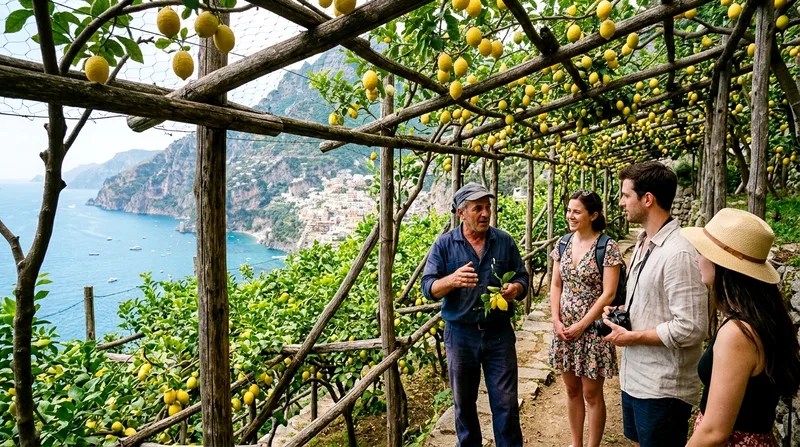
These typically run 2 to 4 hours and combine a guided walk through active terraces — often family-run groves above Amalfi, Minori, or Furore — with a tasting at the end, sometimes paired with other local products like fig jam or fresh ricotta. Expect explanations of the pergolato trellis system, irrigation using centuries-old stone channels, and harvest timing. The appeal is context: you see where the lemons grow before you taste what's made from them. The downside is weather dependency — groves offer little shade, and an August midday walk can be uncomfortable. Spring (April–May) and early autumn (September–October) are noticeably better for this format.
Distillery Visits and Tastings
A limoncello distillery tour usually takes 60 to 90 minutes and focuses on the production process indoors — copper stills, maceration tanks, bottling lines — followed by a guided tasting of several varieties, sometimes including crema di limoncello or other citrus liqueurs. These run rain or shine and need far less physical effort than a grove walk, which makes them a reliable choice for senior travelers or anyone short on time in Sorrento or Amalfi town itself. The trade-off: you lose the agricultural context entirely. You're tasting a finished product without seeing the raw material, which some visitors find oddly disconnected from the "Amalfi Coast" branding on the bottle.
Make-Your-Own Workshops
These run longer — often 2.5 to 3.5 hours — and let participants peel lemons, combine them with alcohol, and bottle a take-home souvenir, though the full maceration process (which needs weeks) is usually simulated or skipped, with a pre-made batch used for the actual tasting. This format suits families with children over roughly age 8 who want something participatory rather than purely a tasting, and couples looking for a slightly novel activity beyond beach time. The catch: the souvenir bottle you "make" often isn't truly aged by the time you leave, so manage expectations — you're mostly bottling and labeling, not distilling from scratch.
Comparison: Tour Formats & Experiences
Beyond the three categories themselves, two structural choices affect the experience more than people expect: group versus private, and half-day versus full-day.
Grove walks demand the most physically but offer the most context, while distillery visits are the easiest and fastest option.
Amalfi Coast limoncello tour types compared: duration, difficulty, and group format
| Tour Type | Typical Duration | Physical Difficulty | Group Size | Best For |
|---|---|---|---|---|
| Lemon grove walk | 2–4 hours | Moderate (steps, slopes) | Small group or private | Scenery and agricultural context |
| Distillery visit | 60–90 min | Low | Group or private | Time-limited visitors, production detail |
| Make-your-own workshop | 2.5–3.5 hours | Low | Small group | Families, hands-on souvenir seekers |
| Combined grove + distillery | 3–5 hours | Moderate | Small group or private | Food and drink enthusiasts wanting both |
Durations and difficulty vary by specific route and operator; always confirm terrain and group size before booking.
Group vs. Private Tours
Group tours — typically 8 to 20 people — cost less and run on fixed schedules, which works fine for distillery visits where the format is largely passive. For grove walks, though, larger groups move slowly on narrow paths and you'll spend real time waiting on stone steps for others to pass. Private or small-group tours (4 to 8 people) cost more but let the guide adjust pace, which matters if you're traveling with older relatives or young kids. If you're a solo traveler on a budget, joining a scheduled group tasting in Amalfi or Positano is the more economical route and still social.
Half-Day vs. Full-Day Options
Half-day limoncello-focused tours (3 to 4 hours) suit travelers stacking multiple activities into a Positano or Amalfi day trip — pair one with a boat trip to Capri or a Pompeii excursion earlier that day. Full-day versions often bundle the lemon tour with a broader Amalfi Coast itinerary: a stop in Ravello for the gardens, lunch in Praiano, and the tasting as one component among several. Full-day options make sense if you're not based directly on the coast — say, staying in Salerno or Sorrento — since transport alone eats time. If you're already sleeping in Amalfi or Positano, a half-day tour is more efficient and leaves the afternoon free.
What to Look for When Booking
Tour listings on booking platforms vary a lot in how much detail they give upfront, and the gaps are usually where disappointment comes from.
Inclusions and What's Covered
Check whether transport to and from your hotel is included — many grove walks start at a trailhead that's a drive from central Amalfi or Positano, and taxis on this coast aren't cheap. Confirm how many tastings are included and whether food pairings (local cheese, pastries, or a light lunch) are part of the package or an add-on. For workshops, ask explicitly whether you take home a bottle and what size — some only provide a small sample bottle rather than a full 500ml.
Group Size and Experience Level
Listings should state maximum group size; if they don't, message the operator before booking. For grove walks, also ask about terrain specifics — number of steps, whether there's shade, and if the path is suitable for someone with knee problems. Tours described as "easy" by one operator can still involve more stairs than a typical traveler expects, since almost all Amalfi Coast agriculture happens on terraces.
Cancellation and Refund Policies
Outdoor grove walks are weather-dependent, so check the cancellation window — free cancellation 24 hours ahead is standard on most major booking platforms, but some smaller local operators only offer rescheduling, not refunds. Read reviews specifically for mentions of last-minute cancellations due to rain, since this happens more often in shoulder season (October–November) than operators like to advertise.
When to Book Your Limoncello Tour
Seasonal availability shifts more than most visitors assume. Lemon harvest for the primary crop happens roughly from spring through summer, but groves look green and active most of the year thanks to staggered planting and some producers growing a secondary autumn crop. April through June and September through early October offer the best combination of mild walking temperatures and active groves — July and August are viable but hot enough that midday grove walks become uncomfortable, and tour companies sometimes shift start times to early morning to compensate.
Winter (December–February) sees far fewer tour departures, especially for grove walks, since some family-run operations close seasonally. Distillery visits run more reliably year-round since they're indoors. If you're planning a trip for winter, book a distillery visit over a grove walk and confirm operating months directly with the operator, not just the booking platform's calendar. For peak season (July, August, and around Ferragosto in mid-August), book at least two to three weeks ahead — small-group and private tours sell out faster than generic coach excursions out of Sorrento or Salerno. Compare current limoncello tours and prices before you book, since availability and seasonal schedules shift year to year.
Frequently asked questions
What is included in a typical limoncello tour?
Most include a guided walk or distillery visit, an explanation of the production process, and a tasting of two to four limoncello varieties. Some add food pairings like local cheese or pastries, hotel pickup, or a take-home bottle. Always check the listing specifically — "tasting included" can mean a small sample pour or a full seated tasting, and the difference matters if that's your main reason for booking.
How long does a limoncello tour usually take?
Distillery visits run 60 to 90 minutes. Lemon grove walks typically take 2 to 4 hours including the tasting. Make-your-own workshops run 2.5 to 3.5 hours. Full-day combined itineraries that bundle a limoncello stop with other Amalfi Coast sights can run 6 to 8 hours including transport.
Can you buy limoncello directly from tours?
Yes — nearly every distillery visit and most grove walks end near a shop or stand selling bottles directly from the producer, often at prices comparable to or slightly below what you'd pay in a tourist shop in Amalfi or Positano. Buying directly also usually means fresher stock and the chance to ask the producer questions about proof and ingredients.
What is the best time to visit lemon groves?
Late spring (April to June) and early autumn (September to early October) offer the best conditions — mild temperatures for walking and visibly active groves. Midsummer groves are still working, but heat makes walking tours less comfortable. Winter sees reduced grove tour availability since some smaller operations pause outdoor walks.
Do you need hiking experience for lemon grove tours?
No formal hiking experience is required, but you should be comfortable with stairs and uneven stone paths — some routes involve several hundred steps cumulatively with minimal shade. If you have knee or balance issues, ask the operator for a difficulty rating before booking, or choose a distillery visit instead, which requires little to no walking.